 
Home > Glossary > TOC > Mark > Mark 16 > The Empty Tomb > Verses > Mark 16:2a | 1a 1b 1c | 2a 2b 2c | 3a 3b | 4 | 5a 5b 5c | 6a 6b 6c 6d | 7a 7b | 8a 8b 8c | Mk 16:2a ... And very early to-the first (day) of-the week, ...
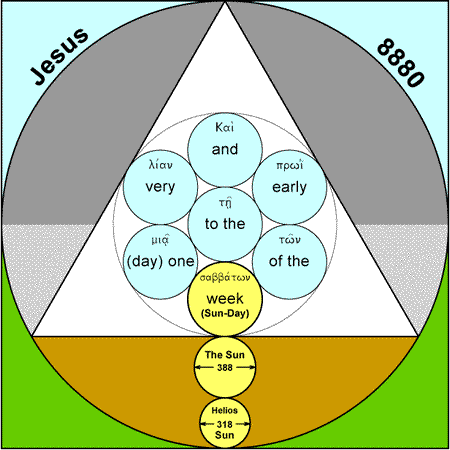
Verse 2 has 3 phrases and 14 narrator words. The 1st phrase has these 7 words ... Kai lian prōi tē mia tōn sabbatōn [And very early to-the first (day) of-the week, ...). The 7 words are top down. The diagram shows the sky starting to brighten next to the high Sabbath. The 3 words "Kai lian proi" (and very early) approx. the end of the 4th watch of the night, 6 AM. The 4 words "te mia ton sabbaton" (to the one of the week) idiomatic genitive ablative, meaning "first (day) after the Sabbath," an idiomatic expression meaning "Sunday." Jesus may have risen inside the tomb at 3 AM, 36 hours after he died. Since this Sabbath occurred during the Spring Equinox (the day and night are equal) this satisfies the prophecy that he would rise after three days. The previous chapter showed how Jesus was probably entombed at 4 PM. If the great stone was rolled away at the tenth hour of the night (10 Christ circles fill the tomb) the time would be 4 AM which means Jesus would have been entombed for 36 hours or three days. If the great stone sealed the tomb at 6 PM on Friday and if Jesus left the tomb at 6 AM sunrise on Sunday, his actual entombment from Friday night to Sunday at dawn would be exactly 36 hours or "three days." No matter how you look at it, the prophesy was exactly fulfilled. The resurrection of Jesus was a new Genesis, a new Sunrise. 16:1c < Verse > 16:2b |
Copyright © 1998-2020 Daniel Gleason, all rights reserved