 
Home
> Glossary >
TOC > Mark > Mark
8 > The Riddle of the Loaves > Verses
> Mark 8:20a
| 14a 14b | 15a 15b 15c | 16 | 17a 17b 17c | 18a 18b 18c | 19a 19b 19c | 20a 20b 20c | 21 | Mk 8:20a ... "When (I broke) the seven (loaves) into the four thousand, ..."
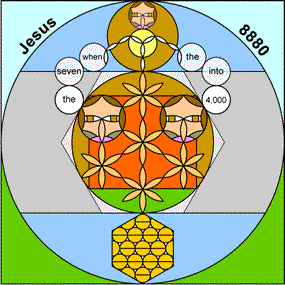
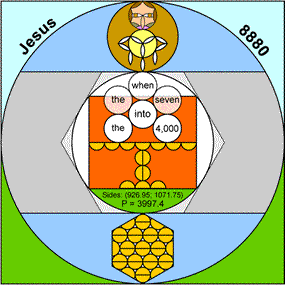
Verse 20 has four phrases and 15 words. The first phrase has these 6 dialog words ... Hote tous hepta eis tous tetrakisxilious ("When the seven into the 4000, ..."). Diagram 1: The 6 dialog words are top down. The 4 words "hepta eis tous tetrakisxilious" (seven into the 4000) are tangent to the boat, the 12 disciples, and the orange rectangle, perimeter 4000, which appears to be tangent to 2 disciples in face mode and the 10 disciples in vesica mode. The word "seven" refers to the 5 stars and 2 faces that represent the 12 disciples. The 2 words "the 4000" refers to the perimeter of the orange rectangle. The text expects you the reader to remember the previous verse and insert the words "I broke" into the start of this one. As Jesus holds the words "hote tous" (when the), it brings to mind the source diagram (Mark 8:6c) for the phrase he just said. Diagram 2: The 6 dialog words "Hote tous hepta eis tous tetrakisxilious" (When the seven into the 4000) are top down and tangent to a circle the same size as the boat holding this orange rectangle with a perimeter of "about 4000" units. The word "hepta" (seven) in this diagram refers to "broken loaves." The 6 words are also tangent to and sitting on 7 broken loaves of bread (artoi = 481) in the shape of a table that is also tangent 'into' (eis) the orange rectangle. This is not an amazing coincidence, the above text was composed about two thousand years ago to describe the diagram. 8:19c < Verses > 8:20b |

Copyright © 1998-2020 Daniel Gleason, all rights reserved