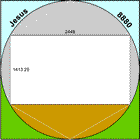
 The Basic Sacred Geometry Signs of ChristianityEuclid only used a compass and a straightedge to construct diagrams to prove his geometry theorems were true. The narrator of the Gospels also only used a straightedge, compass, and the alphanumeric Greek language to construct diagrams, called signs, that proved their gospel stories, called parables, were true. The first step is to draw a circle of any arbitrary size and assign it a circumference of 8880 units. A square enclosing that circle is the raised Jesus graph. Color the top half blue and bottom green. This is the Cosmos, Heaven and Earth.
Using a compass, straightedge, and grid you can construct whatever sized "sign" is needed for a gospel word and put it in your glossary or lexicon. The ten basic constructions are the equilateral triangle, the right triangle, hexagram, hexagon, rhombus, trapezoid, square, rectangle, circle, and radius chord vesica. These ten basic constructions can be further divided, worked on, and colored to make as many different signs as called for by the text. Every important word in the gospel has a sign. Similar nouns can share the same shape but have a different size or color. Nineteen special signs of different sizes are determined by the gematria value of twelve key nouns, three names, and two titles. Now you can draw people and things to make a story. Each gospel verse is a drawing instruction. Each gospel story is a gematria cartoon. The gospel sign miracles performed by Jesus are designed to be amazing and 100% true. This is what the gospels are - sacred geometry stories with interlocking signs tangent to the raised Jesus 8880 circle. |




Copyright © 1998-2023 Daniel Gleason, all rights reserved